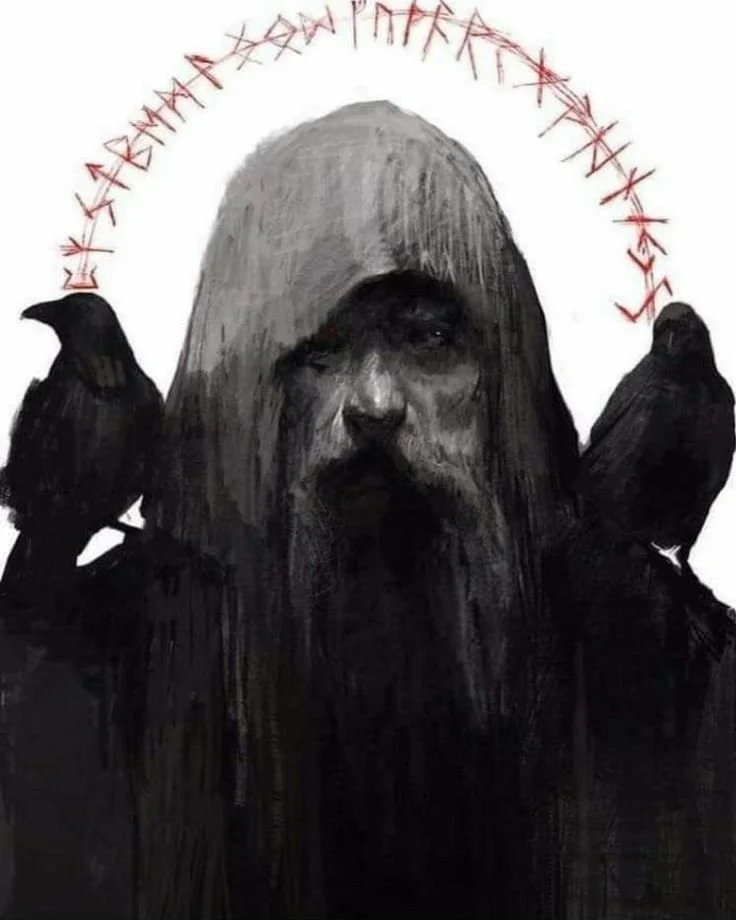
Huginn and Muninn
He Who Thinks
He Who Remembers
The Raven Messengers
-
Hugin and Munin
Source: https://norse-mythology.org/gods-and-creatures/others/hugin-and-munin/Hugin and Munin (pronounced “HOO-gin” and “MOO-nin”; Old Norse Huginn and Muninn, the meaning of which will be discussed below) are two ravens in Norse mythology who are helping spirits of the god Odin.
-
According to the medieval Icelandic historian Snorri Sturluson, Two ravens sit on his (Odin’s) shoulders and whisper all the news which they see and hear into his ear; they are called Huginn and Muninn. He sends them out in the morning to fly around the whole world, and by breakfast they are back again. Thus, he finds out many new things and this is why he is called ‘raven-god’ (hrafnaguð).
-
Snorri’s main source for this passage seems to be an evocative stanza in the Eddic poem Grímnismál, in which Odin says:
Hugin and Munin
Fly every day
Over all the world;
I worry for Hugin
That he might not return,
But I worry more for Munin.
-
The connection between Odin and ravens is very old and very deep. Already in the sixth and seventh centuries AD – well before the beginning of the Viking Age in the late eighth century – visual depictions of Odin on helmets and jewelry frequently picture him accompanied by one or more ravens.
-
The skaldic poetry of the Viking Age often uses kennings involving ravens to refer to Odin, and vice versa. (A kenning is a common Old Norse literary device that uses images from a body of traditional lore to refer to something rather than calling it by its everyday name.) Odin is called the “raven-god” (Hrafnaguð or Hrafnáss), the “raven-tempter” (Hrafnfreistuðr), or “the priest of the raven sacrifice” (Hrafnblóts Goði; this is surely a poetic way of describing fallen warriors as “sacrifices” to the ravens and other carrion birds, with Odin as a decider of who lives and who dies in battle). In the same vein, ravens are called “the greedy hawks of Odin” (átfrekir Óðins haukar), or else his “swan” (Yggs svanr), his “seagull” (Yggjar már), or – showing how far the bird equivalencies could be stretched – his “cuckoo” (Gauts gaukr).
-
Sometimes kennings use “Hugin” as a substitute for “raven.” Blood is designated as “Hugin’s sea” (Hugins vör) or “Hugin’s drink” (Hugins drekka). The warrior in battle is “the reddener of Hugin’s claws” (fetrjóðr Hugins) or “the reddener of Hugin’s bill” (munnrjóðr Hugins). Battle is “Hugin’s feast” (Hugins jól). The poets occasionally use Munin’s name in the same way, but Hugin’s is far more common.
-
Furthermore, the sight of ravens immediately following a sacrifice to Odin was taken as a sign that the god had accepted the offering.
Why was there such a longstanding and intense connection between Odin and the raven, of all species? As those kennings suggest, the answer largely has to do with Odin’s roles as a god of war and death. Ravens, as carrion birds, were present when a battle took place, and were some of its prime beneficiaries. To slay someone in battle was, in a sense, to give the ravens a gift.
-
Countless kennings express this concept: to cite but two, the warrior is the “feeder of the raven” (hrafngrennir) and the “fattener of the battle-starling” (folkstara feitir). But the gift of a dead man also went to Odin, due to his role as the ruler of the dead in Valhalla and the common practice of symbolically sacrificing an enemy host to Odin before a battle. Thus, the association between the raven and Odin was only natural for the Norse.
Yet there’s still more to this connection. Ravens aren’t only birds of gore and carnage; they’re also exceptionally intellectual birds, and Odin is an exceptionally intellectual god.
-
This aspect of the connection is indicated by the names of Hugin and Munin. Hugin (Old Norse Huginn) comes from the word hugr, “thought.” Munin (Old Norse Muninn) comes from the word munr, which is more difficult to translate, but can encompass the concepts of “thought,” “desire,” and “emotion.” (The two ravens’ names are often translated as “Thought” and “Memory” in popular works on Norse mythology, and “Thought” is quite accurate, but “Memory” is at best imprecise and rather arbitrary.) The two names therefore can’t be neatly distinguished from one another; they overlap to the point of being virtually synonymous. This reflects the fact that, in the sources, Hugin and Munin don’t have distinct personalities. They’re a duplicate form of the same underlying idea.
-
More specifically, their names refer to their being concrete visualized forms of the “thought” of Odin. In the Norse worldview, the self is comprised of numerous different parts that are semi-autonomous and can detach from one another under certain circumstances. These detached parts are frequently imagined in an animal form that corresponds to their underlying character. In the case of Hugin and Munin, they’re Odin’s intellectual/spiritual capabilities journeying outward in the form of fittingly intelligent and curious birds that also resonate with Odin’s roles as a battle god and death god.
-
The sending forth of spiritual aspects of oneself to accomplish particular tasks – in the case of Hugin and Munin, the gathering of additional wisdom and knowledge to add to Odin’s already-prodigious store – was a common practice by historical Norse shamans and sorcerers. It should therefore be unsurprising to find Odin, the divine shaman and sorcerer, doing likewise.
-
This also explains why Odin fears that Hugin and Munin might not return to him. Whenever a practitioner of magic sent out a part of himself (or, more commonly, herself) on some quest or another, there was some risk that the parts would become separated from each other, or that injuries suffered by the emissary would also be inflicted upon the rest of the person who had sent it out. Such magical powers certainly didn’t come without their dangers, and even a god like Odin wasn’t exempt from them.
Read More Jormungandr The Great Cosmic Serpent click
Read More Ymir The First Giant Jotun The Story of Creation click
Read More Fenrir The Giant Wolf He Who Dwells in the Marshes click
Read More Surtr The Great Black Fire Giant Jotunn Guardian click
MALNÀTT - Huginn & Muninn
Lyrics Language is Italian Translated into English
Thought and Memory are
just two victims of Time
crows circling
stains in a sky
without glory.
Feathers change
with the changing seasons
nets of lives are knotted
destined to remain silent
forever.
Unarmed prophets in chains
They ferociously claw at History
a war lost from the start:
I forgive in vain
patience.
Thought does not exist
knowledge is an illusion
the brain is a container
we can accumulate
but not know
The consciousness
of not knowing:
the acquiescence of every science
to not having omniscience.
We can transmit
genetic data to multiple generations
inherit behavioral codes
emulate or pretend to reject them.
History does not serve to avoid mistakes
but to repeat them and postpone the idea of death.
Follow the black wings that stretch across the realms with 'Odin's Ravens,' an ethereal Nordic ritual by Valhalla Drums. This song delves deep into the mythology of Huginn (Thought) and Muninn (Memory), Odin's faithful companions who fly out each dawn to bring him news of the world.
The lyrics paint a haunting picture of their journey over battlefields and through the shadows of Hel, where they witness the fire and hear the dead. It speaks to the ancient bond between the Allfather and his ravens, a connection so profound that if one should not return, Odin's very thought and memory would break. This is a powerful, cinematic tribute to the silent messengers who carry truth and lies, and whose whispers reveal what none can bear. It’s a journey into the heart of Norse lore, where wisdom is gathered not just from the living, but from the echoes of the dead.
Pictures Videos Music and Additional Reading
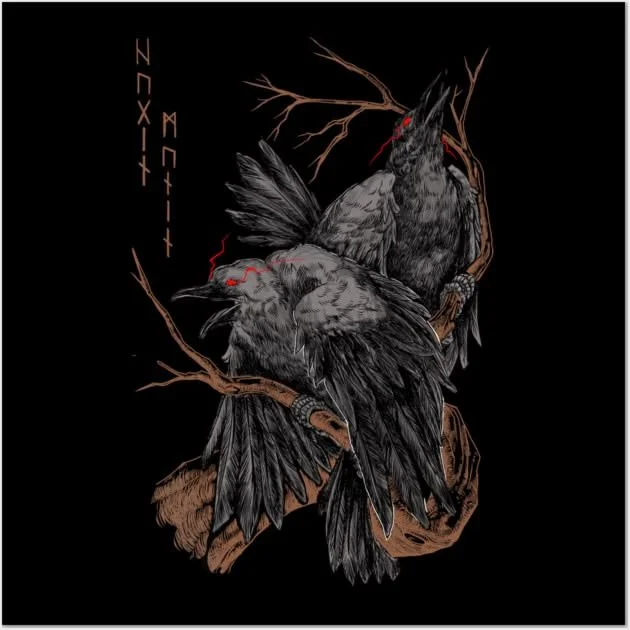
Huginn And Muninn Posters and Art Prints
designed and sold by sajaliArtwork
Source: https://www.teepublic.com/poster-and-art/76059210-huginn-and-muninn?countrycode=US&utm_source=Pinterest&utm_medium=organic&epik=dj0yJnU9NkNZT2NnUGhPOXJSSU5INkk3dHFPUjZyYzVxVmFPNmcmcD0wJm49TWVJMWF4WFZjb0daTW55YnhreEtOdyZ0PUFBQUFBR21pbXhF#477P76059210D6V Munknörr - Huginn and Muninn
One of Odin's names is Hrafnaguð (raven god), because he was associated with two ravens Huginn (thought) and Muninn (memory). According to the Grímnismál
Hugin and Munin travel around the world collecting news and information for Odin.
One of the theories is that it relates to shamanic practices, and Odin's ability to make his thought (Huginn) and mind (Muninn) travel in a trance.
It is known that the raven has a symbiotic relationship with the wolf, many times the ravens help to locate the prey so that the wolves hunt and then the ravens can also eat. The appearance of Odin together with his wolves (Geri and Freki) and his ravens, may indicate the close relationship that they probably had at the time with these animals and nature .
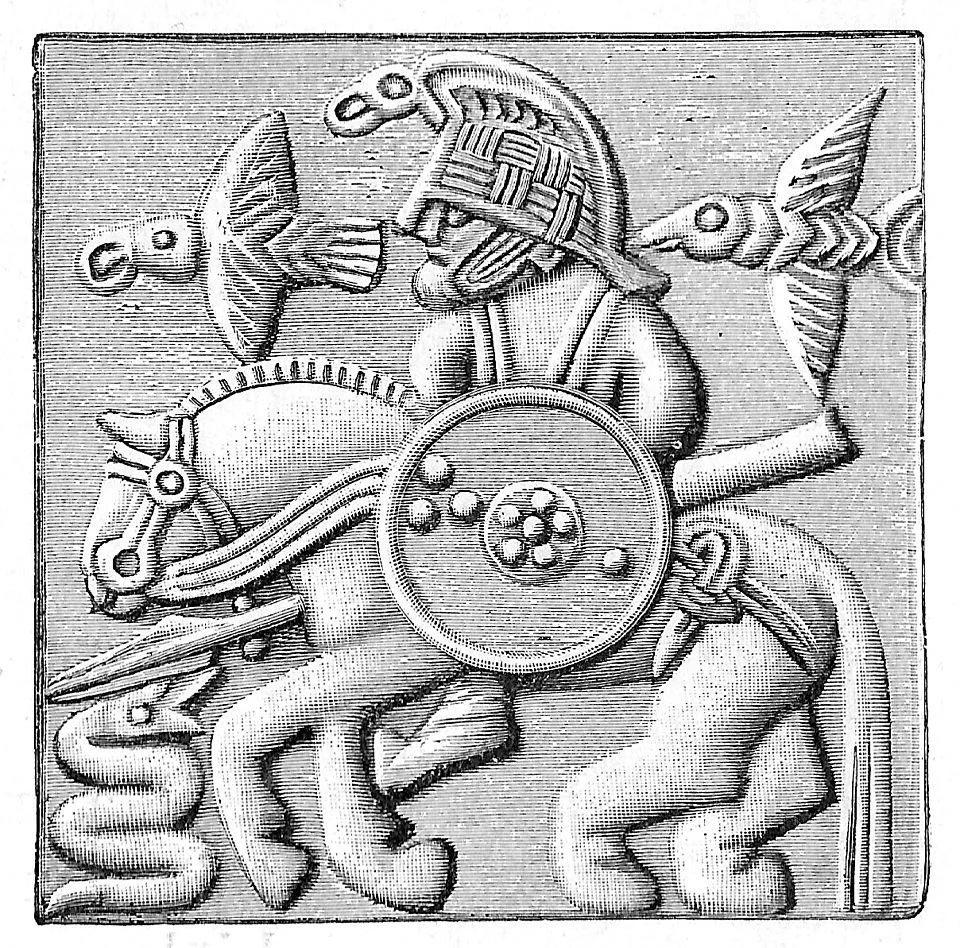
A plate from a Vendel era helmet featuring a figure riding a horse, holding a spear and shield, and confronted by a serpent, accompanied by two birds. The image has been thought to depict Odin with his horse Sleipnir and his spear Gungnir with Huginn and Muninn flying above.
-
In Norse mythology, Huginn and Muninn (sometimes anglicized as Hugin and Munin; /ˈhuːɡɪn, ˈmuːnɪn/ or /ˈhjuːɡɪn, ˈmjuːnɪn/; roughly "mind and will" – see § Etymology) are a pair of ravens that serve under the god Odin, flying around the world (Midgard) and bringing him information. Huginn and Muninn are attested in the Poetic Edda, compiled in the 13th century from earlier traditional sources: the Prose Edda and Heimskringla; in the Third Grammatical Treatise, compiled in the 13th century by Óláfr Þórðarson; and in the poetry of skalds.
-
Etymology
On the surface, the names Huginn and Muninn represent Odin's sense and mind. Their names are definitive singular forms of words which encompass various related but abstract senses. As an example, the English word mind is based on the same root word as Muninn, but encompasses the sense of Huginn when used as a noun, yet with the sense of Muninn when used as a verb. The exact clear definitions and intentions behind these names are hard to extrapolate, but they were probably close to synonyms with several shared and bordering senses.
-
Huginn is the definite accusative singular of Old Norse: hugr (see Hug (folklore); modern Danish: hug, hu; Icelandic: hugur; Norwegian: hug; Old Swedish: hugher, hogher; modern Swedish: håg). It encompasses the complex meaning of mind and sense, such as "thought, perception, comprehension, awareness, mood, sentiment, desire, choice etc". Cognates include Middle English: hige (with variants: huȝe, huiȝe, hiȝe, huie, hiȝ, hie), Old English: hyge, hiġe; Old Saxon: hugi; Middle Dutch: hoghe; Dutch: heug; Gothic: hugs; Old High German: hugu, hugi; with the same meaning.
-
Muninn is the definite accusative singular of Old Norse: munr (modern Danish: mon; Icelandic: munur; Norwegian: monn; Old Swedish: mon, mun; modern Swedish: mån). It encompasses the complex meaning of affection, intent and will, such as "care, urge, yearn, strive, wonder, curiosity, interest, memory, prediction etc". Cognates include Old English: myne; Gothic: muns; Middle High German: mun; with the same meaning, as well as English: mind and Old English: gemynd ("memory, mind").
Read More Jormungandr The Great Cosmic Serpent click
Read More Ymir The First Giant Jotun The Story of Creation click
Read More Fenrir The Giant Wolf He Who Dwells in the Marshes click
Read More Surtr The Great Black Fire Giant Jotunn Guardian click
Source: https://en.wikipedia.org/wiki/Huginn_and_MuninnTwo ravens rise from Valhalla at dawn. Huginn carries thought, Muninn carries memory. Together they cross the world, bringing Odin the stories of men, gods, and blood. This Old Norse choir piece tells their saga – from the whisper of betrayal to the cries of battle, from mourning mothers to the echo of eternity. Dark, powerful and steeped in Viking myth.
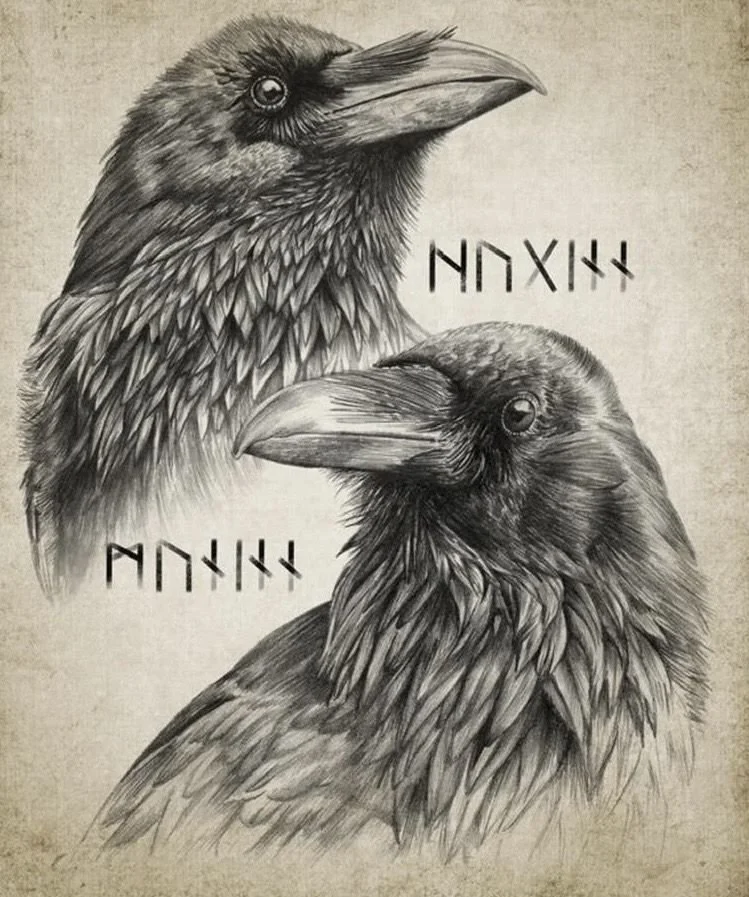
SVARTSOT - Tvende Ravne
[Two Ravens.
This song is about two ravens that are discussing a battle about to take place. Tha ravens (thought and memory) have differing opinions as to how honourable it is to fight and die in the fray. Two ravens, which the song is about, are called Huginn and Muninn -- Odin's two famous Ravens, which he sends out every day to gather information, and they return at night and tell him of everything they've seen.]
Lyrics Language is Danish Translated into English
[1st raven:]
The black raven sits in an ash, looks out on the green plain.
Men in armor gather for war, sharp axes under the blue sky.
[2nd raven:]
The black raven flies from the east, sits in the gray ash.
The raven says "Warriors are coming here, plains are dyed red today."
Two ravens sit in the ash,
Two ravens look at the vale,
Two ravens count exploits,
Memory and thought, they look at everything.
[1st raven:]
The black raven says to the other, "Warriors are coming from the east,
Helmets gleam proudly in the sunlight, (and) banners border the ridge of the hill."
[2nd raven:]
The black raven says to the other, "Here is no place for fear.
Many sons fall here today, mothers weep this evening."
Two ravens sit in the ashes,
Two ravens gaze at the vale,
Two ravens count their achievements,
Memory and thought, they look at everything.
[1st raven:]
The black raven says to the other, "The brave fight hard,
Battle cries resound bravely on the green plain, honor is here to be had!"
[2nd raven:]
The black raven says to the other, "Honor is only the property of the dead,
The cold of the grave turns most, the mead tastes bitter there."
Two ravens sit in the ashes,
Two ravens gaze at the vale,
Two ravens count their achievements,
Memory and thought, they look at everything.