
Adramelech
The Glorious One is King
Sun God of Sepharvaim and Demon of Hell
Adramelech: Sun God of Sepharvaim and Demon of Hell
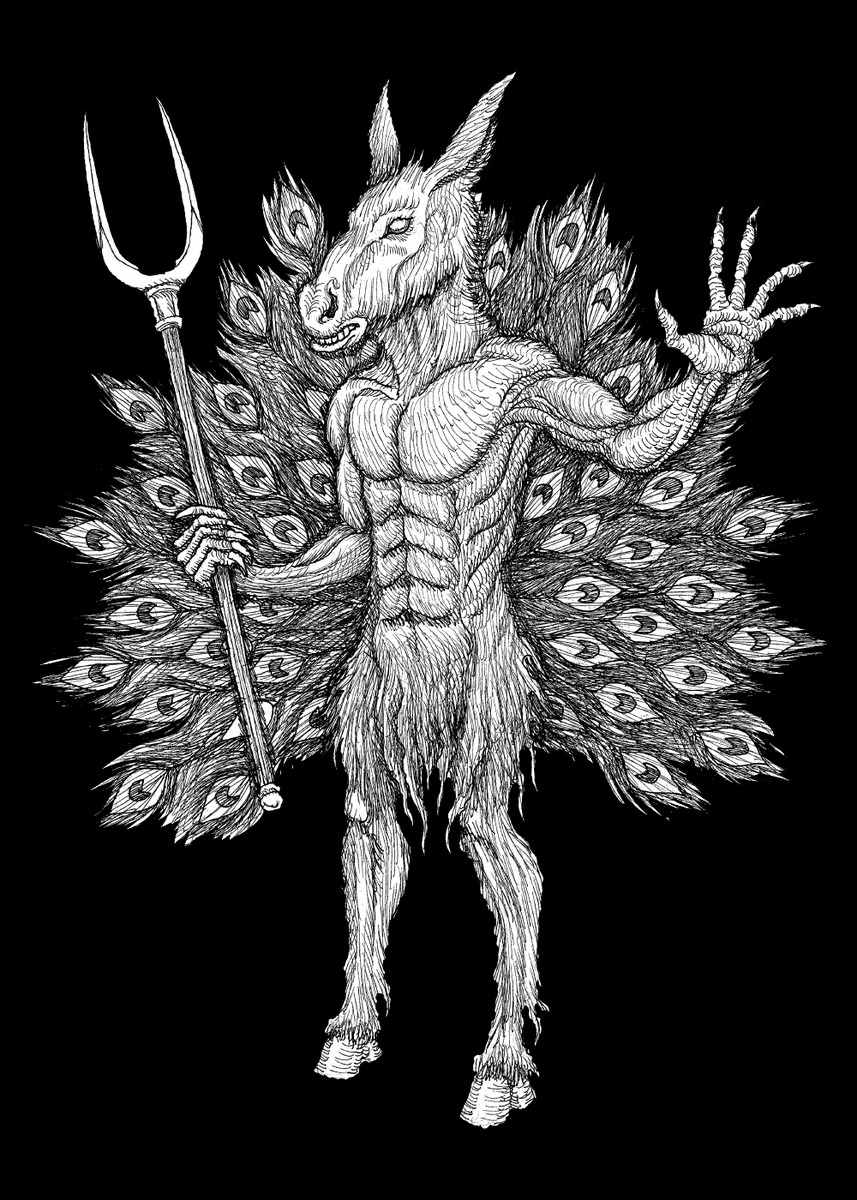
Source: https://www.deliriumsrealm.com/adramelech/According to Collin de Plancy’s Dictionnaire Infernal, Adramelech is a Great Chancellor of the underworld and President of the High Council of Devils. He oversees the king of demons’ wardrobe. He was worshipped in Sepharvaim, a city of the Assyrians who burned children on his altars. The Rabbis say he shows himself with the face of a mule and sometimes as a peacock.
-
Gustav Davidson (1994) describes Adramelech as one of two throne angels (along with Asmadai). In demonology, Adramelech is the 8th of 10 archdemons in Beelzebub‘s Order of the Fly.
-
Adramelech in the Old Testament
The name Adramelech (also Adrammelech, Adramelek or Adar-malik) appears in the Old Testament twice, referring to two distinctly different characters. The first time, Adramelech is mentioned as a son of the Assyrian King Sennacharib who, along with Sharezer, murdered his father while he was worshiping in the temple of his idol, Nisrach (2 Kings 19:36-38 cf. Isaiah 37:37-39). However, the “demon” de Plancy is describing should not be associated with this Adramelech.
-
The “demon” that de Plancy describes is referenced in the second instance of Adramelech: the Sepharvite god worshiped by human sacrifice.
‘the Avvites made Nibhaz and Tartak, and the Sepharvites burned their children in the fire as sacrifices to Adrammelech and Anammelech, the gods of Sepharvaim.’ – 2 Kings 17:313
-
What Do We Know About Adramelech?
To date, no mention of the Hebrew name Adramelech has been found on Assyrian inscriptions, so scholars and bible commentators have been left to speculate. The name Adramelech is most likely a reconstruction of the Western Semitic “Addir-Melek” meaning “the glorious one is king,” a fitting name for a sun deity. The link between Adramelech and Moloch comes from the practice of worshiping both deities by burning children.
-
The name “Anammelech,” the second deity mentioned in II Kings 19, is derived from the Babylonian divine name “Anu(m)” plus the Western Semitic noun “melek” (king). This deity may refer to the male counterpart of the goddess Anat.
-
Philip Schaff mentions both stories of Adramelech in his Dictionary of the Bible (1880). In reference to 2 Kings 17:31, Adram’melech (king of fire) is an idol-god of Sepharvaim who represents the sun while a similar idol-god, Anammelech, represents the moon. Worshippers sacrificed their children to these idols. In reference to Isaiah 37:38, Adrammelech, son of King Sennacherib, and his brother Sharezer killed their father while he was in the act of idolatry. Afterward, they fled to Armenia and Esar-baddon was crowned King. Schaff depicts him with a lion’s body, a beard and wings.
-
What Do We Know About Sepharvaim & Its Deities?
Not much is known about the city of Sepharvaim, its people, or its deities. To date, theologians, Biblical scholars, and Near Eastern archaeologists have proposed a number of places where Sepharvaim may have been.
These include:
Phoenicia, thus associating Adrammelech with Phoenician deities
Syria, equating Sepharvaim with Sibraim
Babylonian Sippar – the city’s chief sun god was Shamash
the Chaldean territory of Bit Awukani where Assyrian Saparre/ Babylonian Sipir’ani were thought to be located (south of Nippur)
Both the modern-day Dictionary of Deities and Demons in the Bible and Mesopotamia and the Bible consider the latter to be the most likely based on name/language analysis comparing linguistic roots with names of kings and deities found on archaeological artifacts, but there’s no conclusive archaeological evidence of Sepharvaim’s exact location, nor which deities its people may have worshiped.
-
Adramelech in Paradise Lost
Adramelech is briefly mentioned as an angelic being defeated and vanquished from Heaven by archangels Uriel and Raphael in Milton’s Paradise Lost.
Uriel and Raphael his vaunting foe,
Though huge and in a rock of diamond armed,
Vanquished-Adramelech and Asmadai,
Two potent Thrones, that to be less than Gods
Disdained, but meaner thoughts learned in their flight,
Mangled with ghastly wounds through plate and mail. – Book 68
-
In Friedrich Gottlieb Klopstock’s Der Messias (The Messiah), an epic poem influenced by Paradise Lost, Adramelech is “a spirit in guile and malice exceeding Satan” who both worked with Satan against God and aspired to overthrow Satan and take over his realm.
-
First appeared Adramelech, a spirit in guile and malice exceeding Satan, against whom his bosom still boiled with indignant rage, for being the first who attempted the apostacy, which he himself had long before projected. The actions he performed were not to advance Satan’s kingdom, but his own.
-
From years immemorial he had been considering how to raise himself to the dominion of hell ; how to engage the prince of the fiery deep in a fresh war against the Eternal : how to cause him to be for ever banished to the infinite space: or, if all failed, how he might subdue him by force of arms.
-
Mary Hanford Ford claimed the book was a favorite of the young Johann Wolfgang von Goethe, who took delight in the wild language between Satan and Adramelech and loved the scene where Satan and Adramelech plunged into the Dead Sea. He and his sister Cornelia, who always voiced the part of Adramelech, would recite their favorite scenes until their father caught them and forbade the book.
-
Adramelech in the Key of Solomon
French Occultist Eliphas Levi published a fragment of the Key of Solomon in his ‘Philosophie Occulte,’ Serie II that describes Adramelech as one of the demonic counterparts to the Kabbalistic Sefirot, corresponding with Hod or eternal order.
-
The eighth Number is eight. The eighth Sephira is Hod or eternal order. The Spirits of Hod are the Beni-Elohim or Sons of the Gods. Their empire is that of order; they correspond to the inner sense. They have for adversaries the Samael or jugglers, whose Chief is Adramelech.
-
Adramelech’s Peacock Form
Presbyterian minister Matthew Henry equates Adrammelech’s worship with peacocks and associates him with Moloch in his Complete Commentary on the Whole Bible (1706):
If we may credit the traditions of the Jewish doctors, they tell us that Succoth-Benoth was worshipped in a hen and chickens, Nergal in a cock, Ashima in a smooth goat, Nibhaz in a dog, Tartak in an ass, Adrammelech in a peacock, Anammelech in a pheasant. Our own tell us, more probably, that Succoth-Benoth (signifying the tents of the daughters) was Venus. Nergal, being worshipped by the Cuthites, or Persians, was the fire, Adrammelech and Anammelech were only distinctions of Moloch. – Commentary on 4 Kings (2 Kings) 17:3112
-
Presumably, this is the same tradition de Plancy references when he describes the demon as appearing in the shape of a peacock.
Pictures Videos Music and Additional Reading
ADRAMELECH - ECCLESIA SATÁNICA | Demonology Ambience, Dark Ambient Music, Black Ambient, Evil Sounds
Adrammelech
Source: https://en.wikipedia.org/wiki/AdrammelechAdrammelech /əˈdræməˌlɛk/ (Biblical Hebrew: אַדְרַמֶּלֶךְ, romanized: ʾAḏrammeleḵ; Koine Greek: Ἀδραμέλεχ Adramélekh) is an ancient Semitic god mentioned briefly by name in the Book of Kings, where he is described as a god of "Sepharvaim". Sepharvaim (a word which is grammatically dual) is commonly, but not certainly, identified with the twin cities of Sippar Yahrurum and Sippar Amnanum on the banks of the Euphrates, north of Babylon. The name Adrammelech probably translates to "Magnificent king."
Biblical account
2 Kings 17:31 reports: "The Sepharvites burned their children in the fire as sacrifices to Adrammelech and Anammelech, the gods of Sepharvaim" (NIV). The Sepharvites are given as a people deported by the Assyrians to Samaria. Adrammelech and the god Anammelech (about whom likewise little is known) are again seemingly alluded to in 2 Kings 18:34: "Where are the gods of Hamath and Arpad? Where are the gods of Sepharvaim, Hena and Ivvah? Have they rescued Samaria from my hand?" (NIV). Isaiah 36:19 has an almost identical passage.
Interpretation
According to A. R. Millard, Saul Olyan, and others, Adrammelech likely represents an original *ʾAddîr-meleḵ, "majestic king" or "the majestic one is king".[1][3][4] Cognate ʾAddîr-milk, along with similar Milk-ʾaddîr (with the morphemes inverted) and Baʿal-ʾaddîr ("majestic master" or "majestic Baal"), is recorded in ancient Semitic sources as an epithet of Baal, or a baal.[1][4]
Adrammelech is commonly understood as a companion of Anammelech, due to their association in 2 Kings 17, the similarity of their names, and the similarity of their worship through child sacrifice.[1]
Before the identification with epigraphic ʾAddîr-milk, various attempts (since generally rejected) were made to interpret the origin of the name Adrammelech.[1][5]
The reconstructed form Adar-malik (or the variant Adru-malku) was once almost universally accepted as the original Akkadian form of the name.[6] For example, Eberhard Schrader wrote in 1885:
"Adrammelech means 'Adar is prince'. It […] was pronounced in Assyrian Adar-malik (Assyr.-Babylon. Keilinsch., selected proper names no. 33a p. 140). [...] Both Adar and Anu, Anuv are very frequently mentioned deities of Assyria. Adar, originally pronounced A-tar, is a word of Akkadian origin and means 'father of decision'. It resembles Nam-tar (literally 'decision, destiny, destination', likewise name of the 'plague-god')."[7]
Peter Jensen proposed in the late nineteenth century that אדרמלך (ʾAḏrammeleḵ, "Adrammelech") was a manuscript error for אדדמלך (ʾĂḏaḏmeleḵ, "*Adadmelech"), due to the typographical similarity of ר (r) and ד (d), which Jensen thought was a variant of unrecorded חֲדַדמֶּלֶךְ (Ḥăḏaḏmeleḵ, "King Hadad" or "Hadad is king"), thus identifying Adrammelech with the Canaanite god Hadad.[1][8] Adad is in fact recorded as a variant of Hadad;[9] but Millard writes: "If the Sepharvites were of Aramean or Phoenician origin, it is very unlikely that the name of their god would have lost its initial h, unless the Hebrew authors of Kings copied the information from a cuneiform text in Babylonian, which would not express it."[1]
At the turn of the century, William Muss-Arnolt suggested that ʾAḏrammeleḵ could represent his own reconstructed Akkadian Atra-malik, comparing the form to the names Atra-ḫasis and (A)tar-ilu, writing, "Atra-malik would probably yield אדרמלךְ."[5]
In the Talmud
From the Jewish Encyclopedia:
The Talmud teaches (Sanh. 63b) that Adrammelech was an idol of the Sepharvaim in the shape of an ass. This is to be concluded from his name, which is compounded of אדר "to carry" (compare Syriac אדרי), and מלך "a king." These heathens worshiped as God the same animal which carried their burdens (Sanh. l.c.; see also Rashi's explanation of this passage which interprets אדר "to distinguish," by "carrying"). Still another explanation of the name ascribes to the god the form of a peacock and derives the name from adar ("magnificent") and melek ("king"); Yer. 'Ab. Zarah, iii. 42d.[2]
Demonology
Like many pagan gods, Adrammelech is considered a demon in some Judeo-Christian traditions. He appears in Milton's Paradise Lost, where he is a fallen angel who, along with Asmodeus, is vanquished by Uriel and Raphael. According to Collin de Plancy's book on demonology, Infernal Dictionary, Adrammelech became the President of the Senate of the demons. He is also the Chancellor of Hell and supervisor of Satan's wardrobe.[10] He is generally depicted with a human torso, a mule's head, a peacock tail, and the limbs of a mule or peacock. In the Ars Goetia, he was known as Andrealphus.