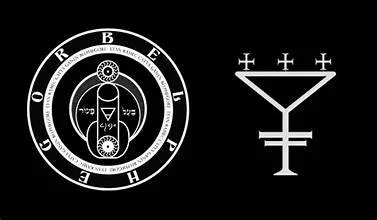
Belphegor
Lord of the Gap
Demon of Sloth
Sources: https://en.wikipedia.org/wiki/Belphegorhttps://thehorrorcollection.com/belphegor-moabite-god-seductive-maiden/https://voiceofthorns.com/2025/02/03/belphegor/”Then they yoked themselves to the Baal of Peor, and ate sacrifices offered to the dead;” -Psalm 106:28
“So Israel yoked himself to Baal of Peor. And the anger of the LORD was kindled against Israel.” -Numbers 25:3
Belphegor
Belphegor (or Baal Peor, Biblical Hebrew: בַּעַל-פְּעוֹר, romanized: baʿal-pəʿōr, lit. 'Lord of the Gap') is, in Christianity, a demon associated with one of the seven deadly sins. According to religious tradition, he helps people make discoveries. He seduces people by proposing incredible inventions that will make them rich. According to some demonologists from the 17th century, his powers are strongest in April.
Read More The Seven Deadly Sins The Seven Kings of Hell click
-
Peter Binsfeld (ca. 1540–ca.1600), the auxiliary bishop of Trier and a witch hunter, wrote that Belphegor tempts through laziness. According to Binsfeld's Classification of Demons, Belphegor is the main demon of sloth in the Christian tradition. The anonymous author of the Lollard work, The Lanterne of Light, however, believed Belphegor to embody gluttony rather than sloth.
-
Have you ever wondered why the allure of laziness can feel so overwhelmingly seductive, pulling you away from productivity and into a spiral of inaction? What if behind your most brilliant inventions lurks a malevolent force, promising riches but delivering only moral decay and eternal damnation?
- Belphegor, the insidious demon of sloth, embodies these paradoxes in the dark realms of demonology, tempting mortals with visions of wealth and innovation that ultimately lead to ruin. As one of the Seven Princes of Hell, this enigmatic entity has haunted human imagination for centuries, from ancient Moabite worship to medieval grimoires, serving as a cautionary symbol of how ambition can twist into apathy.
Read More The Seven Deadly Sins The Seven Kings of Hell click
-
Etymology
The name Belphegor derives from the ancient Hebrew term baʿal-pəʿōr, which translates to “Lord of the Gap” or “Lord of the Opening.” This appellation stems from his origins as the Moabite deity Baal-Peor, worshipped at Mount Peor, a site infamous for its association with fertility rites, licentious practices, and ritualistic excesses.
-
In Semitic languages of the second and first millennia BCE, baʿal served as an honorific meaning “lord” or “master,” often applied to local gods, while pəʿōr likely refers to a geographical feature such as a mountain pass, crevasse, or symbolic “opening” tied to phallic worship and fertility cults.
-
Scholars trace the evolution of the name from Baal-Peor in biblical texts to Belphegor in Christian demonology, reflecting the systematic demonization of pagan deities during the spread of monotheistic religions. Some interpretations connect Peor to concepts of “opening wide,” evoking crude associations with flatulence or excrement, as suggested by occult writers like Jacques Collin de Plancy, who linked Belphegor to offerings of human waste.
-
This ties into his role as a tempter of indolence, where laziness is metaphorically “wasteful.” Additionally, connections to Greco-Roman figures like Priapus, a god of fertility and gardens known for his exaggerated phallus, underscore Belphegor’s roots in sexual and reproductive symbolism, which were later corrupted into demonic attributes of seduction and moral decay.
-
In Kabbalistic writings, Belphegor is portrayed as the “disputer,” an adversary to the sixth Sephiroth, Tiferet (beauty), further emphasizing his disruptive and corrupting influence. The name’s pronunciation varies, often rendered as “bel-feh-gor,” with stress on the middle syllable, highlighting its phonetic ties to ancient Semitic roots.
-
Over time, alternative spellings like Beelphegor or Belfagel emerged in medieval grimoires, adapting to European languages and reinforcing his status as an archdemon. This etymological journey illustrates how a once-venerated fertility god was transformed into a symbol of slothful temptation, embodying the shift from ancient polytheism to Christian infernal lore, where Belphegor now represents the perilous intersection of innovation and idleness.
-
Further explorations reveal potential linguistic links to Assyrian influences, where Baal-Peor may have assimilated traits from regional deities associated with mountains and openings, symbolizing gateways to the underworld or hidden knowledge.
-
In some esoteric traditions, the “gap” metaphor extends to spiritual voids, where Belphegor exploits human weaknesses, filling them with false promises. This multifaceted etymology not only enriches understanding of Belphegor’s malevolent essence but also highlights his enduring role in occult narratives as a deceiver who opens doors to damnation rather than enlightenment.
-
What Does the Demon Belphegor Look Like?
Belphegor’s physical manifestation is a study in deception and horror, designed to exploit human vulnerabilities. In his seductive guise, he appears as a beautiful young woman, often nude or scantily clad, with flowing hair and an enchanting smile that lures victims into complacency. This form enhances his ability to tempt through allure, masking his true intent to foster laziness and discord.
-
In contrast, his demonic visage is terrifying: a grotesque, bearded figure with leathery, mottled skin, curved horns protruding from his forehead, sharp, jagged teeth, and clawed hands ready to ensnare souls.
-
Accounts describe a gaping mouth symbolizing insatiable greed, a long, thorny tail, and eyes glowing with malevolent cunning. Some depictions add pale skin with black veins, evoking decay, or portray him seated on a toilet, a satirical nod to his associations with waste and indolence, underscoring his role in promoting moral filth.
-
Historical and Mythological Background
Belphegor’s origins trace back to ancient Near Eastern mythology, where he began as a Canaanite and Moabite deity before being demonized in Judeo-Christian traditions. As Baal-Peor, he was a fertility god linked to mountains and openings, possibly sharing attributes with Chemosh, the national god of Moab, known for demanding human sacrifices.
Read More Chemosh The Destroyer Tribe of Moabite
-
Connections extend to other ancient deities worldwide, such as the Assyrian Baal figures or even Egyptian gods like Bes, who embodied protection but could invert to malevolence.
-
In Greco-Roman parallels, his phallic worship mirrors Priapus, while some scholars draw tenuous links to Hindu fertility spirits or Aztec underworld entities, though these are speculative, highlighting universal themes of temptation and decay in global mythologies.
-
This transformation from god to demon reflects broader patterns in religious history, where conquering faiths recast rival deities as evil spirits. Belphegor’s lore intertwines with biblical narratives, Renaissance satire, and occult diplomacy, each story amplifying his corrupting influence.
-
Baal-Peor and the Moabite Temptation
The earliest myth involving Belphegor appears in the Book of Numbers (25:1–18), where he is Baal-Peor, the god of the Moabites at Shittim. As the Israelites camped near Moab during their exodus from Egypt, Moabite women, under King Balak’s orders and prophet Balaam’s counsel, seduced Israelite men into participating in fertility rites on Mount Peor.
-
These rituals involved orgiastic practices, sacrifices to Baal-Peor, and worship of his phallic idol, leading to widespread idolatry and moral corruption among the Israelites. Yahweh’s wrath ensued, commanding Moses to impale the leaders and execute transgressors, resulting in a plague that killed 24,000 people. Phinehas, Aaron’s grandson, halted the plague by spearing an Israelite man and Moabite woman in flagrant.
-
This episode cemented Baal-Peor’s reputation as a deceiver, exploiting human desires for fertility and pleasure to sow discord and divine punishment. Archaeological evidence from Moabite sites supports such cults, with inscriptions hinting at mountain worship and ritual openings, reinforcing Belphegor’s ancient ties to licentiousness and ruin.
Read More Baal Bael God of Fertility Weather Tribes of Canaan click
-
Machiavelli’s Belfagor Arcidiavolo
In Niccolò Machiavelli’s 1549 novella Belfagor Arcidiavolo, Belphegor is dispatched from Hell by Pluto (a stand-in for Satan) to investigate rumors that marriage causes earthly misery, sending souls to damnation.
-
Disguised as a wealthy Florentine merchant named Roderigo, Belphegor marries the haughty noblewoman Onesta, whose extravagance and demands quickly bankrupt him. Forced into debt and servitude, he flees, possessing peasants and causing chaos, but ultimately prefers Hell’s torments to marital strife.
This satirical tale, drawing from medieval folklore, portrays Belphegor as cunning yet outmatched by human folly, emphasizing his role in exposing and exacerbating discord.
Machiavelli uses the story to critique Renaissance society, with Belphegor’s failures highlighting the demon’s deceptive nature—promising bliss but delivering ruin—while expanding his mythological reach into literary commentary on greed and relationships.
-
Ambassador to France and Parisian Decadence
According to 19th-century occult texts, Belphegor serves as Hell’s ambassador to France, residing in Paris’s underbelly, such as the catacombs or sewers. This role ties him to French cultural elements of debauchery, like cabarets, erotic literature, and revolutionary excess, where he fosters indolence among intellectuals and artists.
-
His enmity with Mary Magdalene, France’s patron saint symbolizing repentance, underscores a cosmic rivalry, with Belphegor countering her purity by promoting sloth and vice.
Legends depict him influencing historical figures, whispering inventions that lead to moral decay, such as during the Enlightenment when scientific advances masked spiritual neglect. This narrative expands Belphegor’s mythology, portraying him as a diplomatic tempter infiltrating human societies to spread corruption, aligning with his origins while adapting to European folklore.
-
Belphegor in Kabbalistic Disputes
In Kabbalistic traditions, Belphegor acts as the “disputer,” opposing the Sephiroth of Tiferet (beauty and harmony). He challenges divine order by sowing doubt and laziness, disrupting spiritual balance.
-
Myths describe him debating angels or tempting mystics with forbidden knowledge, leading to their downfall. This role connects him to broader esoteric adversaries, like other disputing demons, emphasizing his intellectual malic.
Read More Qlippoth Tree of Death Hierarchy of The Arch Demons Demonology Kabballah click
Read More Baal Bael God of Fertility Weather Tribes of Canaan click
Read More Chemosh The Destroyer Tribe of Moabite
Read More The Seven Deadly Sins The Seven Kings of Hell click
BLACK FUNERAL- "Lord Of The Dead - Tiphereth (Belphegor - Paimon) Tagahrim"
Lyrics
The revolt against god
Brings the awakening of the spirit
No hunger constricted
Yaïmien, great spirit of Lucifer
Embrace with dreaming knowledge
Mastery of the earth, Black Sun
Burning my dreams, calling me into nightmares
Belphagor, Lord of the Dead
Encircle the shades ento me
That strength shall find me
Here the spirit is devoured cast asunder
Brought before the shadows
Those of our faith
Bury in the trials of the soul
Found as predators among the sheep
Are uplifted to god
The revolt against god
Brings the awakening of the spirit
No hunger constricted
Yaïmien, great spirit of Lucifer
Transformation, awaken me as God

Belphegor: The Demonic Tycoon in His Lair
An imposing depiction of Belphegor, the demon of wealth and sloth, seated in a luxurious leather armchair surrounded by gold coins and lavish artifacts. His horns and cunning smile convey both power and indulgence, while the dimly lit cityscape behind him enhances his aura of opulence and mystery. Perfect for lovers of dark, occult-inspired art.
Pictures Videos Music and Additional Reading
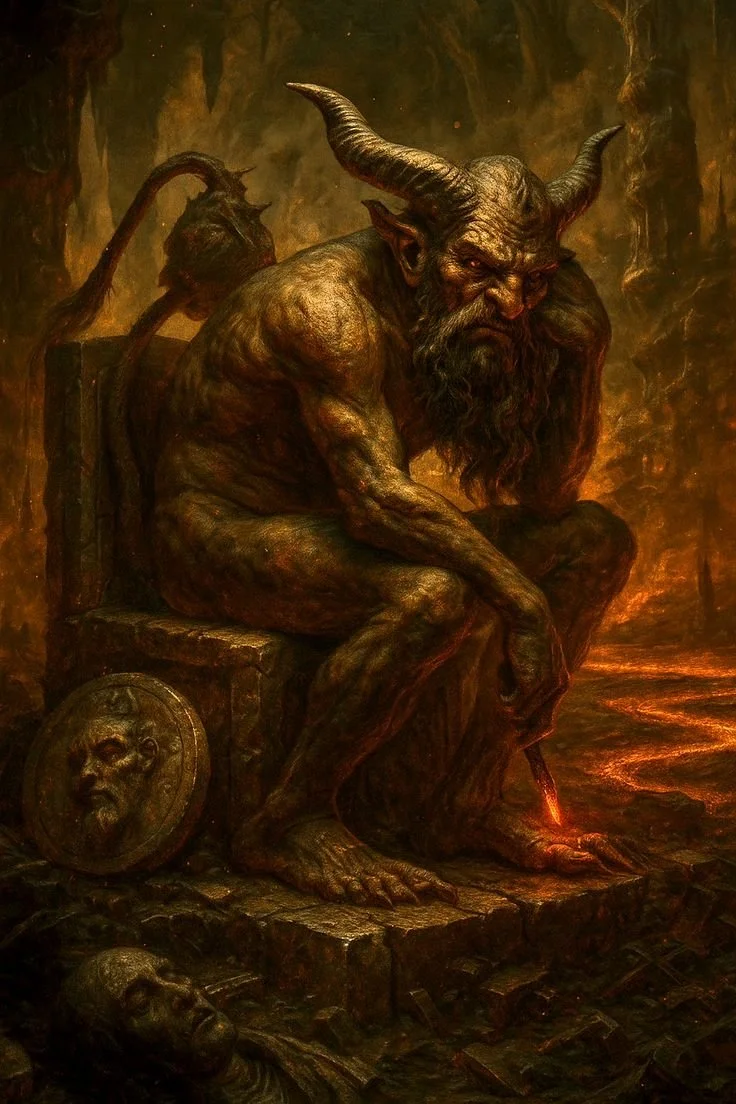
''BELPHEGOR'' Dark Ambient Music Video (1 Hour Occult Meditation)
BELPHEGOR (Orchestral Dark Ambient & Chants Music Video Mix) 1 HOUR DEMONIC MEDITATION
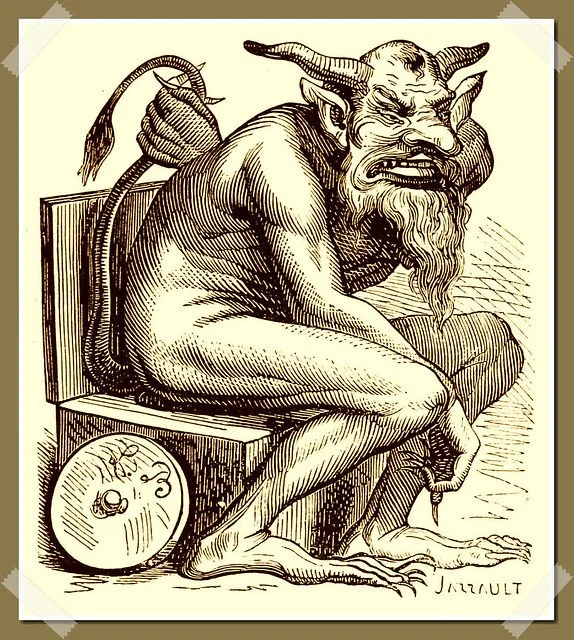
Belphegor as depicted in Collin de Plancy’s Dictionnaire Infernal, 1863 edition.
-
Belphegor : Master of the Opening
Source: https://occult-world.com/belphegor/-
Belphegor is a demon whose origins lie in ancient Moabite religion, later absorbed into Hebrew lore and subsequently transformed within Christian demonology into a major infernal figure. His name is generally understood to mean “lord of opening” or “Lord Baal of Mount Phegor (Peor).” In his earliest form, he was worshipped as Baal-Peor, a Moabite deity associated with fertility, sexual power, and generative force, venerated on Mount Peor (Phegor), located east of the Dead Sea in what is now modern Jordan. His cult involved explicit sexual symbolism, and he was worshipped in the form of a phallus.
Read More Baal Bael God of Fertility Weather Tribes of Canaan click
-
As religious paradigms shifted, Baal-Peor was demonised within Hebrew tradition and later Christianity, becoming Belphegor, a spirit associated with corruption, mockery, and moral inversion. Rabbinical sources describe obscene rites associated with his worship, including homage rendered upon a perforated chair and offerings consisting of human excrement. This imagery later influenced medieval demonological depictions of Belphegor seated on a toilet or pierced chair, a symbolic insult used by magicians to demonstrate domination rather than reverence.
-
Some scholars equated Belphegor with ancient fertility gods such as Pet (Crepilus) or Priapus, while others, including Selden (as cited by Banier), claimed that human sacrifices were once offered to him, and that his priests consumed the flesh of the victims. Wierus noted that Belphegor was described as having a perpetually open mouth, an observation possibly derived from the name Phegor, which, according to Leloyer, means a fissure or cleft. This interpretation aligns with his association with caves, crevices, openings, and subterranean worship, where offerings were cast through vents or apertures.
-
In Kabbalistic lore, Belphegor is said to have once been an angel of the order of Principalities before his fall. He is counted among the Togarini, meaning “the wranglers,” and is considered an arch-demon forming part of the infernal counterparts to the angels governing the ten sephirot of the Tree of Life. Belphegor is associated with the sixth sephirah, occupying a mirrored position within demonic cosmology.
-
In Christian demonology, Belphegor became identified with one of the Seven Deadly Sins, namely sloth, understood not merely as laziness but as negligence, apathy, procrastination, and moral indifference. According to St. Thomas Aquinas, sins arising from ignorance are rooted in sloth, reinforcing Belphegor’s role as a spirit who undermines effort, responsibility, and purposeful action.
Read More Chemosh The Destroyer Tribe of Moabite
-
Belphegor is also said to rule misogyny and licentious men. One legend claims that he emerged from Hell to investigate human marriage and sexuality. Disguised as a man, he lived among humans to experience sexual pleasures firsthand. Disgusted by what he observed, he fled back to Hell, relieved that such relations did not exist there.
-
Despite his association with sloth and ruin, Belphegor is paradoxically known as the demon of discoveries and ingenious inventions. He tempts humans by inspiring brilliant innovations, ambitious projects, and creative ideas—often those doomed to failure through overreach, greed, or lack of perseverance. In Hell, he rules over inventions and discoveries and is sometimes described as its infernal patron of failed genius.
-
Belphegor bestows wealth, riches, and inspiration, but he is considered difficult to conjure and highly unreliable. If he takes a liking to a person, he may grant great treasures, financial success, and inventive brilliance; however, legends warn that such gifts often lead to downfall. He delights in sowing discord, encouraging greed, and luring individuals to ruin through their own ambitions.
-
He is also said to serve as infernal ambassador and guardian of France, particularly Paris, where he allegedly resides. He is believed to preserve and protect the erotic and risqué elements of French culture, including cabarets and so-called French postcards.
-
Belphegor is a shape-shifter who delights in unexpected manifestations. He may appear as a beautiful young woman or naked maiden to tempt men, or as a horned, monstrous spirit with jagged claws. Misinterpretations of his name led to descriptions of him with an eternally open mouth, though this more accurately refers to his dominion over symbolic openings such as caves, wombs, and sexual organs. In ancient times, Baal-Peor presided over ecstatic and erotic rites on Mount Peor, condemned by Hebrew prophets as abominations.
In modern culture, Belphegor has occasionally appeared in art and literature. In 1955, Australian artist Rosaleen Norton was charged with obscenity following an exhibition that included a painting titled Belphegor.
-
The palindromic prime number 1000000000000066600000000000001 is known as Belphegor's prime, due to the superstitious significance of the numbers it contains. Belphegor's prime number consists of the number 666, surrounded on both sides by thirteen zeros and finally one one.
According to De Plancy's Dictionnaire Infernal, Belphegor was Hell's ambassador to France. As a result, his enemy is Mary Magdalene, one of the patron saints of France.
Source: https://en.wikipedia.org/wiki/BelphegorBELPHEGOR - Hell's Ambassador (OFFICIAL MUSIC VIDEO)
Lyrics
Ritual Human - sacrifices - upon thee
Bring us power - of discovery - ingenious
Inventions....
Deity crepitus - we summon you!
BELPHEGOR - envoyed from hell by Lucifer
Hell's Ambassador
BELPHEGOR - envoyed from hell by Lucifer
Thy priests - contort their flesh
[Lead: Helmuth]
BELPHEGOR - licentiousness upon thee
[Lead: Sigurd]
Orgies in - in the sign - of the phallus
Seduced us to - evil through - the apportionment
Of wealth...
Deity crepitus - we summon you!
BELPHEGOR - envoyed from hell by Lucifer
Hell's Ambassador
BELPHEGOR - envoyed from hell by Lucifer
Conjuration - by the feces
Licentiousness upon thee
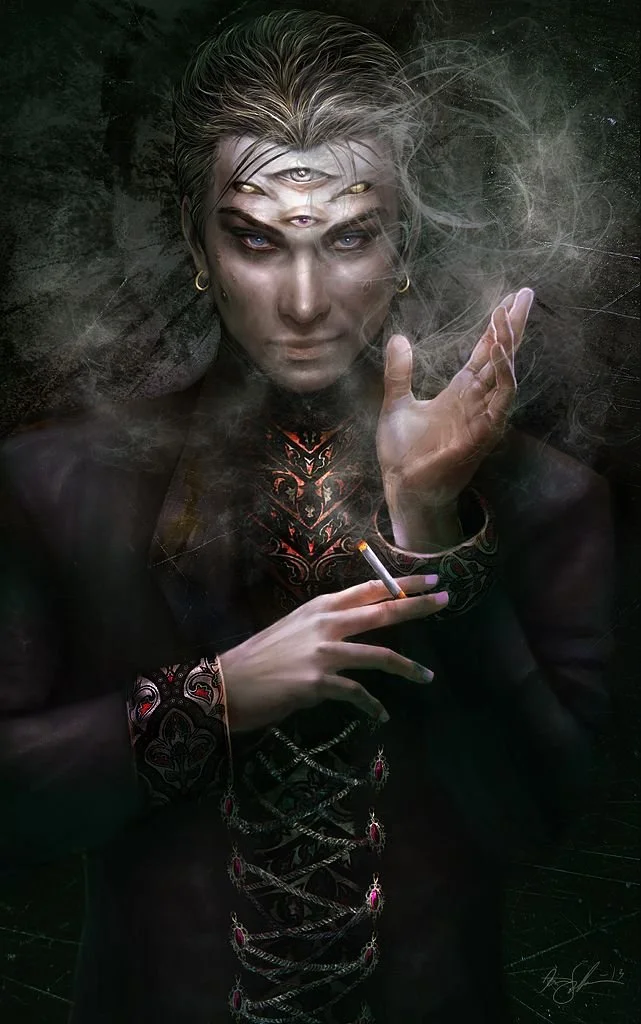
"Belphegor - Vanity" by Kirsi Salonen.
Belphegor - Embracing a Star ·
Lyrics
I embrace a star - the pentagram, it illuminates
The cosmic energies - of the eternal divine
Lay before me - flesh to adore!
The body below - only a tool
Primal force of nature's core
Fill me now, gimme more
Instincts must yield - to the magickal rule!
I am rooted
I am perfect
I am ready
I open my arms - legs wide apart
Touch the five points
The shape is complete
Every man and every woman is a star
Sex-Magick, self-creation
I am the giver
I am the taker
I am the receiver
Bigger than life - I embrace a star
Fueling its core - to burn ever more
Emotionless passion - simple and cruel
I enter the Fleisch - to please myself
Creating and growing - within my own skin