
Jahannam
The Seven Levels of Hell Sea Lake of Fire
-
AI Overview
In Islamic tradition, Jahannam (Hell) is depicted as a vast, fiery abyss with seven distinct descending levels, or gates, each with increasing severity of punishment tailored to different categories of sinners and disbelievers. Ranging from relatively lower punishment to absolute anguish, it serves as a place of divine justice.
-
The seven levels, often cited in descending order of severity, are:
Jahannam: The highest level, reserved for sinful Muslims who will be purified of their sins before being admitted to Paradise.
Laza: The "Blazing Flame," prepared for those who turned away from the truth, were arrogant, and gathered wealth without sharing.
Al-Hutamah: The "Crusher," for backbiters, slanders, and those who hoard wealth rather than spending it on the needy.
Sa'ir: The "Raging Fire," meant for those who consume the property of orphans, disregard Islamic law, and defy Allah.
Saqar: The "Scorching Fire," intended for those who neglected to perform daily prayers, denied the Day of Judgment, and didn't feed the poor.
Jaheem: The "Intense Fire," a place for idol worshippers and those who rejected the message of Allah.
Al-Hawiyah: The "Abyss," the deepest, darkest, and most severe level, reserved for the worst sinners, specifically the hypocrites (Munafiqun) who appeared to have faith but did not.
-
The "sea of fire" in Islam refers to the Quranic description of the oceans being set ablaze or overflowing with fire, primarily as a sign of the Day of Judgment (At-Takwir 81:6) or as a symbolic oath (At-Tur 52:6) indicating the hidden wonders of creation. It is also interpreted by some as a prophecy referencing, either literally or metaphorically, underwater volcanic activity or the discovery of oil/fossil fuels.
-
Key Aspects of the Sea of Fire in Islam:
Quranic References:
Surah At-Tur (52:6): Mentions "And by the sea filled with fire" or "the sea that is set on fire" (Al-Bahri al-Masjur), used as an oath.
Surah At-Takwir (81:6): Describes a scene from the Day of Judgment: "And when the seas become as blazing Fire" (Wa idha al-biharu sujjirat).
-
In Islam, the equivalent to the "lake of fire" or a place of torment is Jahannam (Hell), described as a roaring fire intended for disbelief and evil-doing. It is portrayed as having seven levels, with the deepest levels reserved for the most severe sins, representing divine justice.
-
Jahannam (Hellfire): The Quran describes Jahannam as a place of blazing fire, often depicted with intense heat and profound suffering for those who disbelieve or commit evil deeds.
-
Levels of Hell: Similar to the biblical concept of lower depths, Islamic tradition commonly refers to seven distinct levels or gates of Jahannam, each with specific punishments.
-
Iblis (Satan) in Fire: In some Islamic traditions, including those mentioned in popular literature, Iblis is described as being chained at the bottom of hell.
-
"The Fire" and Divine Justice: Jahannam is considered a necessary component of divine justice in the afterlife.
Lake of Fire vs. Jahannam: While the Book of Revelation describes a "lake which burneth with fire and brimstone," the Quranic description of Jahannam as a deep, punishing fire is a direct parallel for the ultimate destruction of evildoers.
The concept of Jahannam is a core tenet of Islamic eschatology, emphasizing accountability in the afterlife.
Bathory - Lake of Fire
Lyrics
Twinkle bright Aldebaran, the star of solitude
Somewhere there is a lake of fire, pity all the fools
Sorry are the desolate, the unfree and obedient
For this is not the spring of love, it is the winter of discontent
Standing at the shore of lake of fire
Standing at the shore of Lake Of Fire
Standing at the shore of Lake Of Fire
Standing at the shore of Lake Of Fire
Blood mooney, for thirty pieces of silver
You shall buy yourself the time
The quivering meat conception, deflorate the virgin fair
Succumb to your own passion, receive the garland made from angel's hair
Crown yourself, the thorns will cut you, bleed your majesty
But by dawn it will all satisfy no more, dethrones you weep
Dumped along the shore of lake of fire
Dumped along the shore of Lake Of Fire
Dumped along the shore of Lake Of Fire
Dumped along the shore of Lake Of Fire
So you've been left in chains to rot away in your own stinking rest
You'll hang till death in your own entrails
What you're gonna do, peasants with nukes
But death you'll see shall make us free
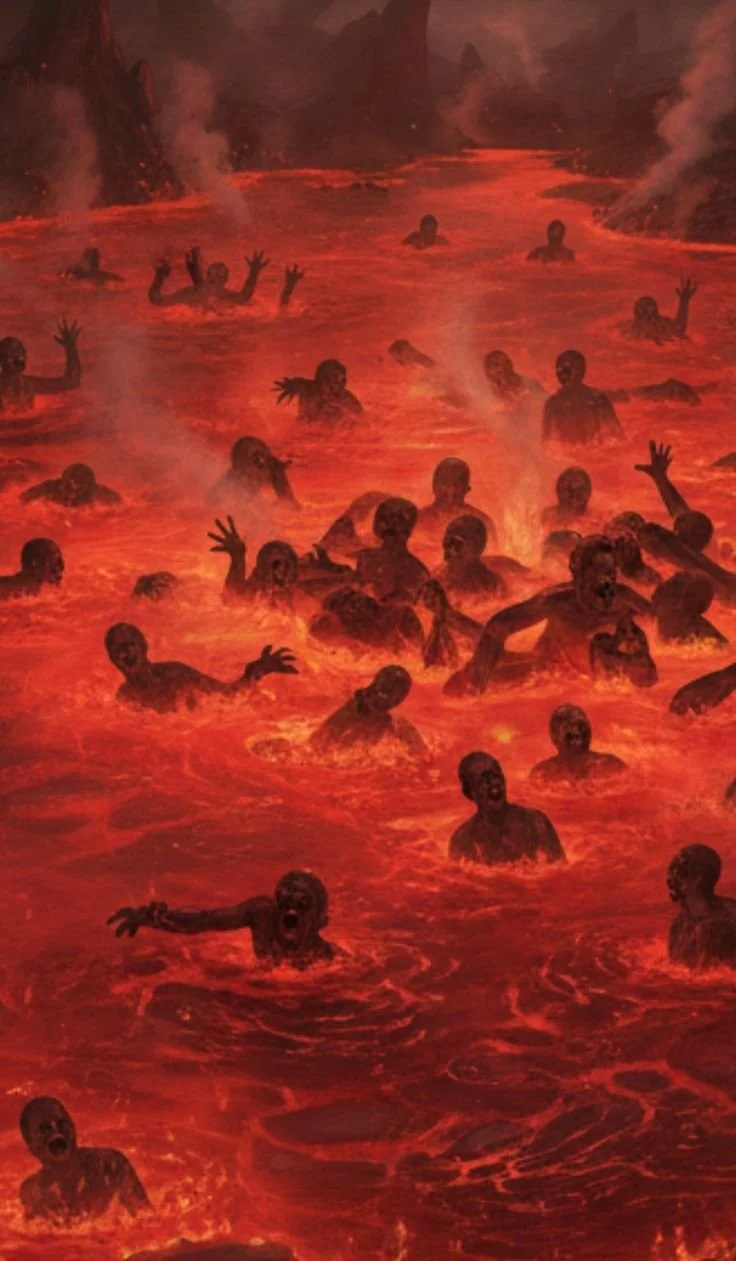
Burning Point - Lake of Fire
Lyrics
Look at me now, I'm bleeding
the river runs red, no more dreaming
the dream is over, we lost the war
the sun is rising, the last time, nevermore
Remember these words: fragile is the life
hold on to the truth, death is not the end
my pulse is getting slower, my hands are numb
I look at the sky, blinded by the sun
[Chorus]
The Lake of Fire - the holy-land is in flames
betrayed by liar - the whole nation face the end
The Lake of Fire - the soulless one's to blame
betrayed by liar - for only fortune and fame
Betrayed by my brother, forsaken by my kin
look at him now, torn apart by enemy within
the war is over, hatred grew stronger
remember me now, as I am no longer
[Chorus]
The last echoes of the dying hope
carried by the wind, the end is closing in
no retreat, no surrender
is there a reason for this fight?
or are we pawns in a game
like puppets on strings
born without sins,
we are losing it all?
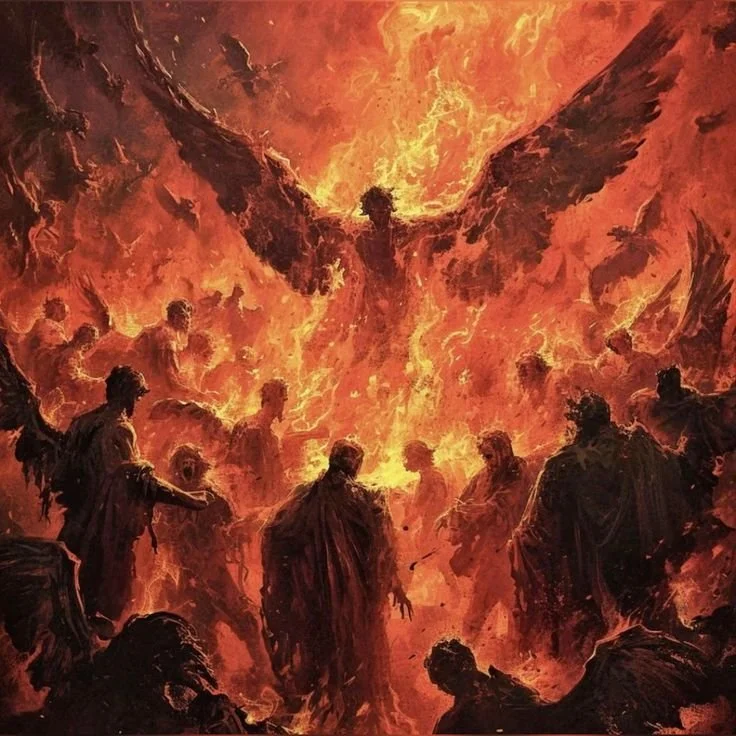
Nocturnus - Lake Of Fire
Lyrics
Bones crushing
Skulls smashing
In the Vice
Of hell
Demons shoving
Tortured souls
In the lake
Of fire
[Chorus 3 Times]
Lake of fire
Spirits forming
Ever swirling
In the abyss
Of hell
Souls screaming
For their lives
In the lake
Of Fire
[Chorus 3 Times]
Lake of fire
Demons swarming
Corpses smashing
Through the gates
Of hell
Satan flying
From his throne
Towards the gates
Of Heaven
Pictures Videos Music and Additional Reading
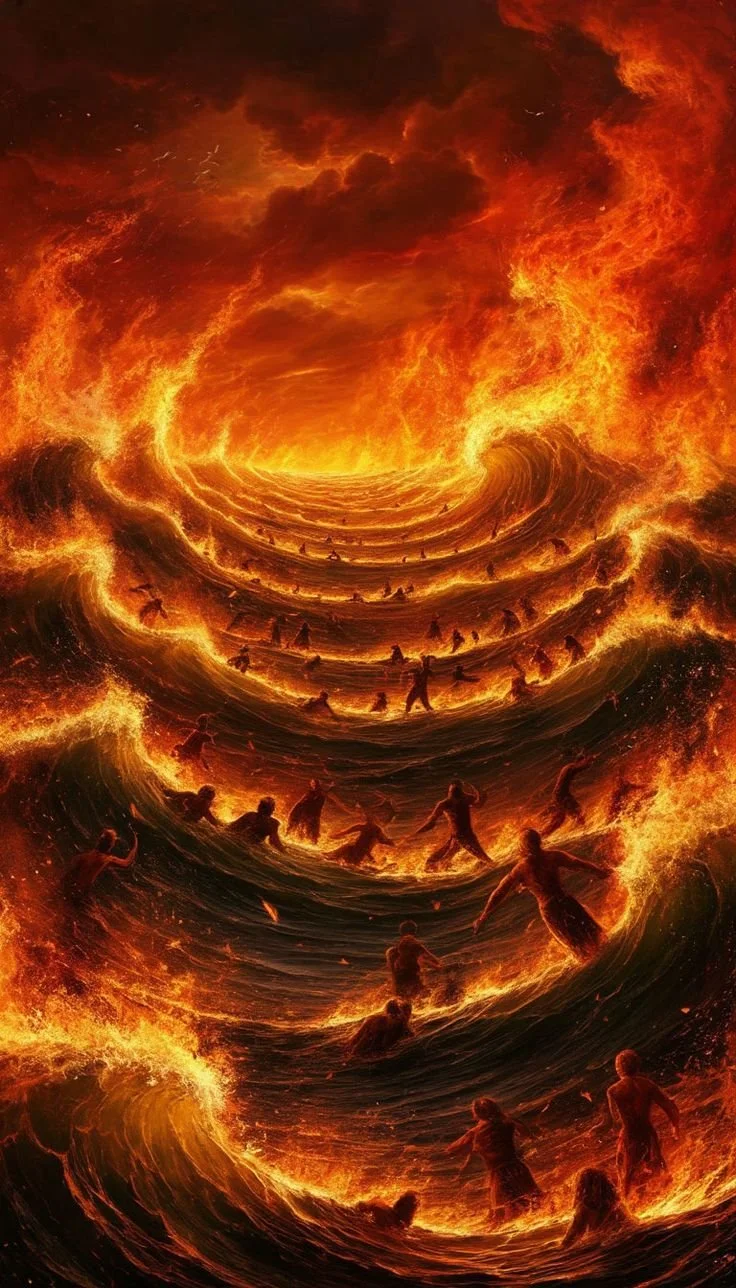
Curse Upon A Prayer - Jahannam
Lyrics
Jahannam! Jahannam!
The endless sea of flaming flesh I see!
Jahannam! Jahannam!
The burning paradise right before my eyes!
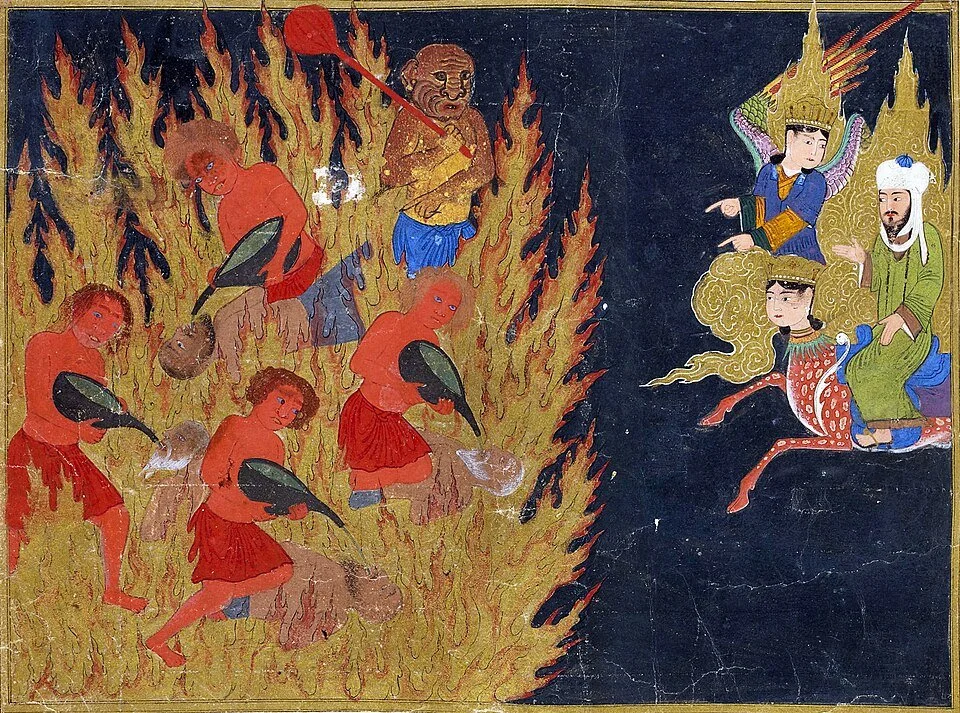
A depiction of Muhammad visiting Jahannam; artwork from Miraj Nameh
Jahannam
Source: https://en.wikipedia.org/wiki/Jahannam-
In Islam, Jahannam (Arabic: جهنم) is the place of punishment for evildoers in the Akhirah / afterlife, or hell. This notion is an integral part of Islamic theology, and has occupied an important place in Muslim belief. The concept is often called by the proper name "Jahannam", but other names refer to hell and these are also often used as the names of different gates to hell. The term "Jahannam" itself is used not only for hell in general but (in one interpretation) for the uppermost layer of hell.
-
The common belief among Muslims holds that Jahannam coexists with the temporal world, just as Jannah does (rather than being created after Judgment Day). Hell is described physically in different ways in different sources within Islamic literature. It is enormous in size, and located below Paradise.
-
It has seven levels, each one more severe than the one above it, but it is also said to be a huge pit over which the resurrected walk over the bridge of As-Sirāt. It is said to have mountains, rivers, valleys and "even oceans" filled with disgusting fluids; and also to be able to walk (controlled by reins), and to ask questions, much like a sentient being.
-
A large number of hadith about Muhammad's tour of hell during the miʿrāj, describe the various sinners and their torments. A summary of the uppermost level of hell, "reserved for deadly sins" and "subdivided into fourteen mansions, one close above the other, and each is a place of punishment for a different sin", was done by Asin Palacios:
-
The first mansion is an ocean of fire comprising seventy lesser seas, and on the shore of each sea stands a city of fire. In each city are seventy thousand dwellings; in each dwelling, seventy thousand coffins of fire, the tombs of men and women, who, stung by snakes and scorpions, shriek in anguish. These wretches, the Keeper enlightens Mahomet, were tyrants.
-
In the second mansion beings with blubber lips writhe under the red-hot forks of demons, while serpents enter their mouths and eat their bodies from within. These are faithless guardians, devoured now by serpents even as they once devoured the inheritances committed to their trust. Lower down usurers stagger about, weighed down by the reptiles in their bellies. Further, shameless women hang by the hair that they had exposed to the gaze of man.
-
Still further down liars and slanderers hang by their tongues from red-hot hooks lacerating their faces with nails of copper. Those who neglected the rites of prayer and ablution are now monsters with the head of dogs and the bodies of swine and are the food of serpents.
-
In the next mansion drunkards suffer the torture of raging thirst, which demons affect to quench with cups of a liquid fire that burns their entrails. Still lower, hired mourners and professional women singers hang head downwards and howl with pain as devils cut their tongues with burning shears. Adulterers are punished in a cone-shaped furnace ... and their shrieks are drowned by the curses of their fellow damned at the stench of their putrid flesh.
-
In the next mansion unfaithful wives hang by their breasts, their hands tied to their necks. Undutiful children are tortured in a fire by fiends with red-hot forks. Lower down, shackled in collars of fire, are those who failed to keep their word. Murderers are being knifed by demons in endless expiation of their crime. Lastly, in the fourteenth and lowest mansion of the first storey, are being crucified on burning pillars those who failed to keep the rule of prayer; as the flames devour them, their flesh is seen gradually to peel off their bones.
Three Valleys; The three valleys in Jahannam described in the Quran on separate occasions are:
Ghayy
Wayl
Saqar
Of these valleys, Ghayy is for those who postpone their prayers to the time of the next prayer, Wayl is for worshippers who neglect their prayers, and Saqar (also described as one of the seven levels above) is for those who did not pray, did not feed the poor, waded in vain dispute with vain talkers, and denied the Day of Judgement until they died.
-
Pit; In addition to having levels, an important feature of Judgement Day is that hell is a huge pit over which the bridge of As-Sirāt crosses, and from which sinners fall making their arrival in hell. Christian Lange writes "it made sense to picture [hell] as a vast subterranean funnel, spanned by the Bridge, which the resurrected pass on their way to paradise, with a brim (shafīr) and concentric circles leading down into a central pit at the bottom (qaʿr)."
-
But along with a pit and levels, hell also has mountains, rivers, valleys and "even oceans" filled with "fire, blood, and pus".
Sentience; Along with being a pit and a series of levels, some scholars, like al-Ghazali and the thirteenth-century Muslim scholar Al-Qurtubi, describe hell as a gigantic sentient being, rather than a place. In Paradise and Hell-fire in Imam al Qurtubi, Qurtubi writes quoting a sahih Muslim hadith:
"On the Day of Judgment, hell will be brought with seventy thousand reins. A single rein will be held by seventy thousand angels ...". Based on verse 67:7 and verse 50:30, Jahannam inhales and has "breaths". Islamicity notes "the animalistic nature" of "The Fire" in Quranic verse 25:12: "When the Hellfire sees them from a distant place, they will hear its fury and roaring". According to verse 50:30, God will ask Jahannam if it is full and Jahannam will answer: "Are there any more (to come)?"
-
Inmates; Thomassen writes that in Islamic thought, there was "a certain amount of tension" between the two "distinct functions" of hell: to punish disbelievers/non-Muslims and to punish anyone who committed serious sins—both of which could draw support from Quranic verses and hadith. Factors involved in who will be consigned to hell are:
-
Unforgiveableness of unbelief. According to Smith and Haddad, perhaps "almost the only point on which Muslim thinkers completely agreed" was that it was "certain that the one unpardonable sin, that for which the pain of the Fire is assured, is refusal to testify to the tawẖīd (the indivisible oneness) of God, called either kufr (unbelief) or shirk (worshiping other besides the one God).
-
That all human beings "are responsible" for their actions in this world, and all (even Muslims) face a "real possibility" of going to hell, (Q.19:71);[149] This theme "has continued to play an important role throughout the history of Islam";
God's freedom to send to Paradise or Hell, whoever he chooses,
"We do certainly know best those who deserve most to be burned therein" (Q.19:70);
"Indeed, Allah does not forgive associating others with Him ˹in worship˺ but forgives anything else of whoever He wills". (Q.4:48);
What sins are considered grave enough to merit damnation ("There is no fixed canon of mortal sins in Islamic theology");
Although grave sins such as usury or murder of another Muslim are not unpardonable in themselves, they are sufficiently serious that those who commit them cease to be Muslims and become guilty of unbelief, a sin that is unpardonable. ("Famous" issue in the theological debates of early Islam between Khawarij, Murji'a, Mutazila, Ash'ari).
"Ultimately" the view of the Ash'arite school prevailed in "classical Islamic theology": God was free to judge as he chose, but on the other hand all believers can feel assured of salvation.
-
Jinn, devils, and angels: according to Islam, the jinn are obligated to follow the Islamic law (sharīʿa). The pairing of humans and jinn as subjects of God's judgement is settled in the Quranic phrase "al-ins wa-l-jinn" ("the humans and the jinn"). Both are created to "serve" ('abada) God (51:56), both are capable of righteous and evil deeds (11:119). The Quran confirms that hell will be filled with both sinful humans as well as sinful jinn.
Read More Jinn Demigods and Demons 10 Types of Jinn click
-
The fate of Satan is less clear. Some say, he and his offspring are already chained in hell (Sijjin), others say he and his hosts will be the first to enter hell, while yet others say, the devils will all perish at Judgment Day. Since Satan and the devils are created from fire, some scholars suggest that they will not burn in fire, but suffer from the intense cold of Zamhareer.
-
A popular opinion among Shias is that the Mahdi will kill Iblis. In some manuals of Islamic eschatology, the Angels of divine justice will seize and kill Iblis, instead. Although there is a disagreement about the exact fate of the devils, most agree that the devils are damned to hell. An exception are the Murji'ah who argue that even Satan might be restored to his former glory.
-
Instead of devils, angels punish the sinners and guard the entrances to hell. These angels were created from the fires of hell, and therefore, do not suffer wherein. They are described as subordinates of God and thus the punishment they inflict is ultimately just.
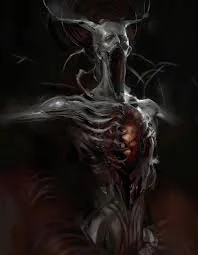
A work in progress. A Zabaniyah, an angel of punishment, a warden of Jahannam.
Source: https://www.instagram.com/aralking/ 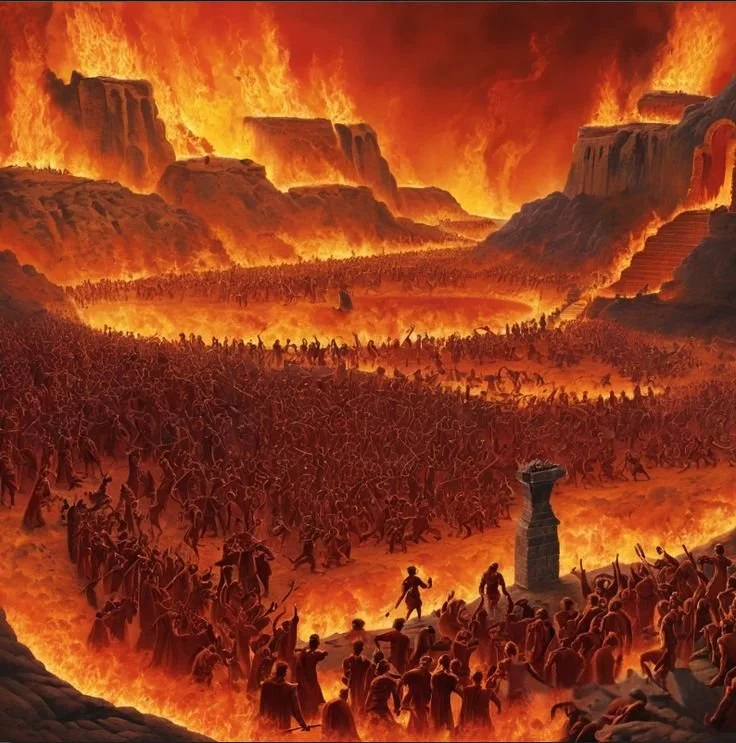
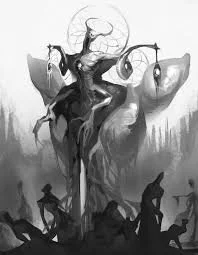
A work in progress. A Zabaniyah, an angel of punishment, a warden of Jahannam.
Source: https://www.instagram.com/aralking/